A contest open to all students
Infrastructure as a System
Rethink infrastructure for a world shaped by climate pressure, technological disruption, regulatory change and shifting demand.
Work in teams to design a project that can adapt to future needs.
The Competition is Closed.
Results to be announced on November 3rd, 2026.
Step 1
Complete the registration form
If you are having an issue, don’t hesitate to contact us and send us your details to the address contact@infravision-thinktank.com.
Step 2
Submit your project to the jury
Any submission sent after 23:59 CEST on the 31st of July, 2026 will not be taken into account!
Learn more about the Competition
Many students answered the call to rethink infrastructure for a world shaped by climate pressure, technological disruption, regulatory change and shifting demand.
The contest was open to creative minds from various backgrounds: architecture, urban planning, engineering, complex systems, economics, public policy, computer science, etc.
Participants had to showcase their ideas for designing a fictional infrastructure project that was not just efficient today, but resilient, adaptive and sustainable across uncertain futures.
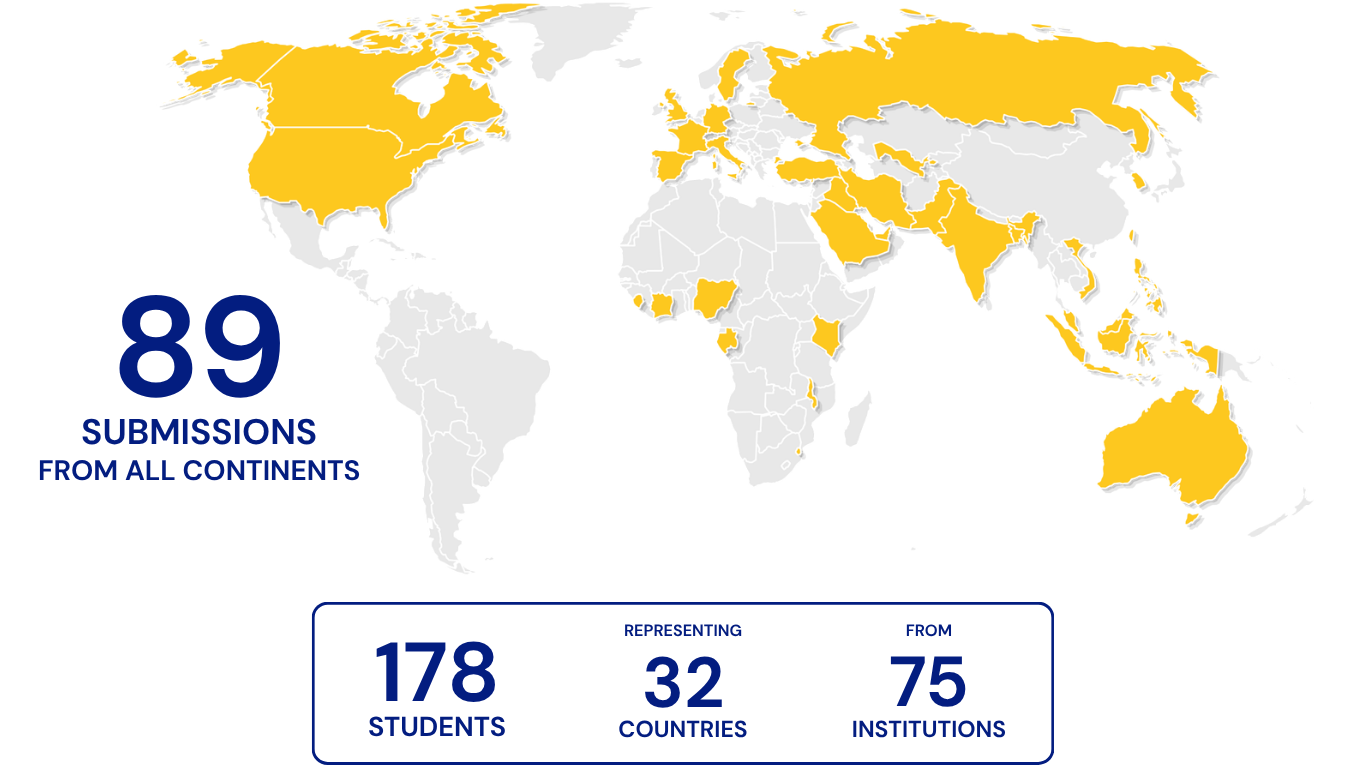
Thank you to all the participants. We received 89 entries from 32 different countries. Results will be announced on November 3, 2026.
Recognized by peers
Awarded by a jury of experts, led by architect Sadie Morgan (founder of Quality of Life Foundation), and the recognized public figures below.


Erik Jones
Director of the Robert Schuman Center for Advanced Studies at the European University Institute,
Patrice Geoffron
Professor at Université Paris Dauphine PSL

Didem Nisanci
Senior Fellow at the Global Climate Policy Project at Harvard University and Massachusetts Institute of Technology, and former Chief of Staff at the U.S. Department of the Treasury
Jean-Michel Blanquer
Former French Minister of Education and President of Terra Academia
The rules were:
- Teams consisting of 1 to 6 members.
- There were no specific requirements related to faculty or disciplinary composition.
- Team members had to be active student status during the academic year 2025-2026.
- Each team had to send at the address contact@infravision-thinktank.
com an email with the following details: - Names, school and department affiliations, degrees studied, and expected graduation dates of all team members.
- A concise overview of their project.
- Contact details.
What was expected from the teams :
- A clear project vision and the value created.
- 2 to 3 plausible future scenarios.
- Key risks, vulnerabilities and adaptation levers.
- Explicit trade offs between competitiveness, resilience, sustainability and performance.
- A system perspective connecting the project to wider ecosystems such as mobility, energy or urban planning.
- A realistic implementation roadmap, budget logic and impact indicator.
Prizes for the winning teams
Who we are
InfraVision is a Think Tank founded by Vauban IP, with the support of Altermind, whose raison d’être is to foster fruitful discussions between infrastructure stakeholders (asset operators, investors, experts, start-ups, policymakers, etc.) on forward-looking and hot topics related to infrastructure. Five major reports have already been released, you can find them here.
2026: A contest for students
In 2026, InfraVision has organized a competition inspired by the theme ‘Infrastructure as a System’. Creative minds from various backgrounds – e.g. students of architecture, urban planning, engineering, complex systems, economics, public policy, computer science, etc. – were invited to team up and join the contest.
A theme: Infrastructure as a System
We invited students to rethink infrastructure for a world shaped by climate pressure, technological disruption, regulatory change and shifting demand.
Students had the opportunity to tackle complex problems by applying their knowledge, skills, and imagination. They will receive valuable feedback from a jury of experts, led by architect Sadie Morgan (founder of teh Quality of Life Foundation), and other recognized public figures, (see above), helping the students raise their profile and establish industry contacts.
The competition offers prize money of 7,000 euros for the 1st-placed team, 5,000 euros for the 2nd-placed team, and 3,000 euros for the 3rd-placed team.
What was expected from contestants?
The submission went beyond a concept and demonstrated structured thinking:
- Project vision and value creation – A defined infrastructure project, its purpose, the problem it addresses, and the value it creates;
- Future scenarios – 2 to 3 contrasted and plausible future contexts (e.g., macroeconomic tensions, geopolitical uncertainties, regulatory shock, technological disruption);
- Resilience and adaptiveness – Identified key vulnerabilities, risks, and uncertainties. Stress-test and showcase of how the project responded to them (e.g., flexibility, modularity, reversibility);
- Trade-offs – Main tensions (e.g., cost vs. speed, efficiency vs. resilience, performance vs. sustainability). Explicit choises and their justification;
- Bold bets and quick wins – High-impact ideas, either forward-looking or actionable in the short term. This may include disruptive technologies, policy or regulatory changes, or innovative business and financing models;
- Stakeholder engagement – Identified key stakeholders and a plan on how to align interests, secure buy-in, and create the right incentives for implementation;
- System perspective – Explanation of how the project interacts with broader systems (e.g., mobility, energy, urban planning) and its role within a wider ecosystem;
Implementation roadmap and budget – Vision translated into a realistic, phased plan. Specified key milestones, conditions, and budgetary requirement; - Impact assessment – A clear single most important indicator of success. Supported with a high-level cost-benefit perspective and explanation of the value created;
The submission included a 30-40 slides + a written abstract, along with visual representations, sketches, digital or physical models, etc.
Opening
Opening of the Call for Proposals
Expression of interest
Applicants send an email with information on the participants and an overview of the project
Deadline
Deadline for submissions, all team must deliver their proposition. July 31th 23:59 Paris time (CET).
The deadline is reached
Review
The jury will evaluate applications.
Results
Annoucement of the results during Paris Infraweek 2026 November 3th
The mission
Infrastructure systems are at a turning point.
Climate constraints, technological disruption, and shifting demand patterns are forcing deep transformations across sectors such as transport, energy, telecommunications, etc. Decision-makers must now navigate an increasingly uncertain landscape, with the concurrent need to deliver the low carbon and ecological transitions.
In this context, traditional approaches are no longer sufficient.
You are part of a strategic task force advising on a fictional infrastructure project (e.g., parking facility, data center, bridge, hospital, ports, rail stations, airports, heating network, highway upgrade, urban logistics hub, etc.). Your challenge is to design this project in a world in transitions (social, digital, energy, ecology), defined by deep uncertainty.
By the time your infrastructure becomes operational, i.e. in 2030-2035, demand may have shifted, technologies may have evolved, regulations may have tightened, and resource constraints may have intensified. In other words, you are designing for a future you cannot fully predict.
Your task is therefore not to design the “best” infrastructure under a fixed set of assumptions, but to imagine one that remains relevant even when those assumptions prove wrong.
The objective is to create a project that can withstand change, adapt to evolving conditions, and continue to deliver financial and extra-financial value across different possible futures.
Participants are encouraged to challenge assumptions and design projects that are not only innovative, but also credible, actionable, and system-aware.
This requires a different way of thinking. You are expected to reason in terms of scenarios rather than certainties, to engage seriously with uncertainty instead of simplifying it away, and to combine strategic thinking with technical understanding and creativity.
Your proposal should reflect deliberate choices and clearly articulated trade-offs between environmental impact, economic viability, resilience, and societal value.
A strong project will anticipate future constraints such as climate pressures, regulatory shifts, and resource scarcity. It will integrate emerging technologies or new operational models where relevant, while remaining grounded enough to be realistically implemented.
Beyond presenting an innovative concept, you should demonstrate how your proposal delivers tangible and measurable impact.
They won last year on the theme "Cities of tomorrow"
1st place – Mohalla Van: a post-masterplan urban design framework for Bhopal
A Post-Masterplan Urban Design Framework for Bhopal, rethinking urban green spaces to create a resilient and community-centered city. Team from the University of Bath, United Kingdom2nd place – Doire Masterplan
A visionary project proposing an innovative framework to transform urban connectivity, sustainability, and community life.
Team from the University of Bath, United Kingdom
3rd place – The Germinating city
An inspiring project exploring how cities can grow organically, using nature-based solutions and community-led design to foster resilience and social inclusion.
Team from the Universidad tecnica de Oruro, Bolivia